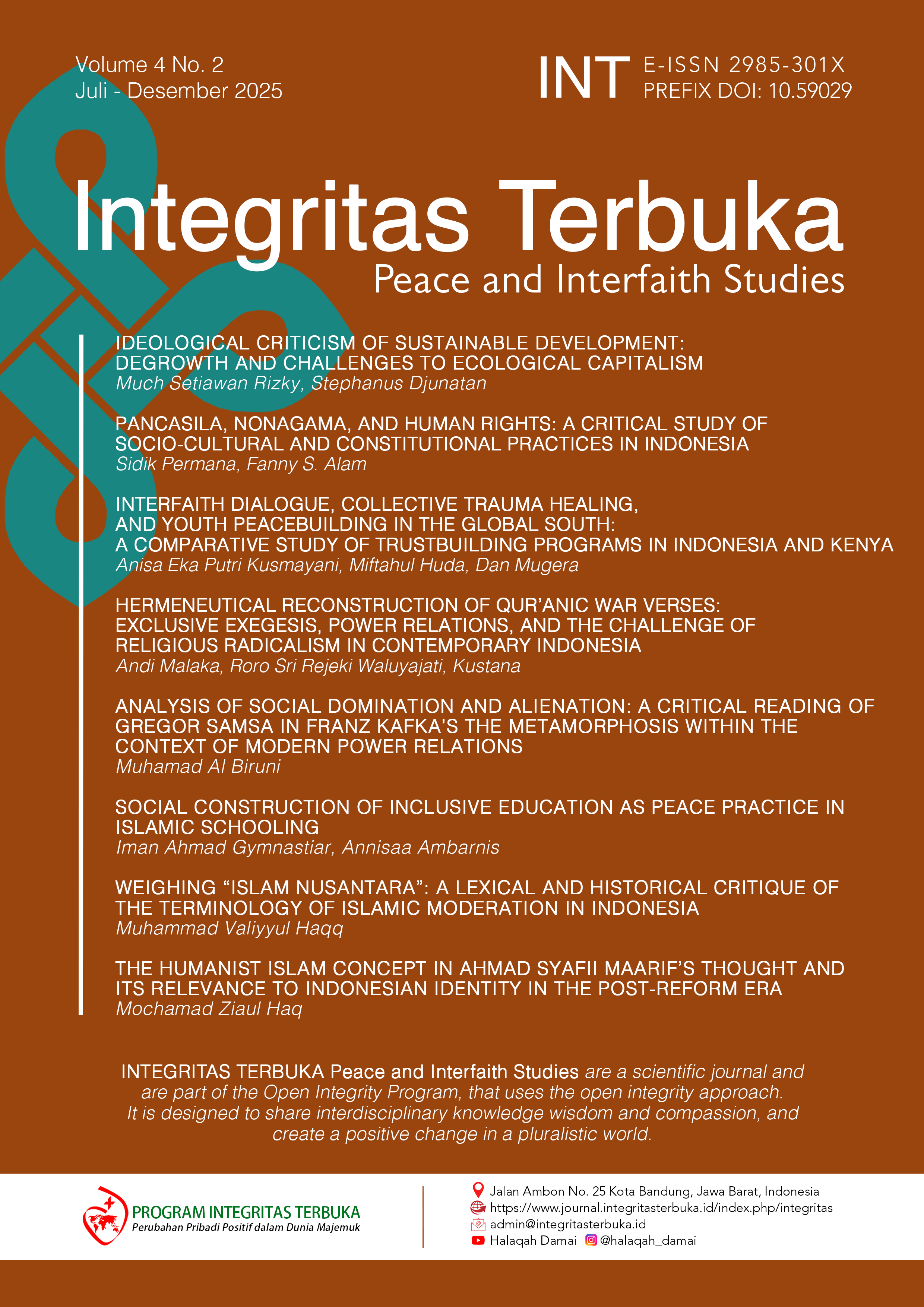
KRITIK KONSEPTUAL ATAS TERMINOLOGI ISLAM NUSANTARA: KAJIAN LEKSIKAL DAN HISTORIS DALAM WACANA STUDI AGAMA
DOI:
https://doi.org/10.59029/int.v4i2.74Kata Kunci:
Islam Nusantara, Terminological Critique, Lexical-Semantic Analysis, Islamic Moderation , Indonesian Religious DiscourseAbstrak
Penelitian ini melakukan kritik konseptual yang sistematis terhadap terminologi Islam Nusantara, suatu istilah yang dipopulerkan oleh Nahdlatul Ulama (NU) untuk merepresentasikan Islam moderat hasil kontekstualisasi nilai universal dengan budaya lokal. Dengan menggunakan kajian leksikal-semantik dan historis-konseptual, studi ini bertujuan membedah implikasi dan potensi ambiguitas istilah tersebut. Hasil penelitian menunjukkan bahwa meskipun intensi di balik Islam Nusantara (moderasi dan kontekstualisasi) bersifat positif, terminologinya mengandung ketidaksempurnaan konseptual. Secara leksikal, frasa Islam Nusantara rentan diinterpretasikan sebagai jenis atau mazhab Islam tertentu, yang berpotensi bertentangan dengan prinsip keuniversalan Islam. Secara historis, narasi yang melekat pada istilah tersebut cenderung didominasi oleh corak keislaman Jawa-Melayu-sentris, sehingga mengabaikan keragaman tradisi Islam lainnya di Nusantara. Kesimpulannya, Islam Nusantara lebih tepat dipahami sebagai strategi wacana dan pendekatan metodologis dalam beragama, bukan sebagai definisi teologis yang kokoh. Terminologi ini adalah proyek identitas yang menegosiasikan universalitas Islam dalam kerangka kebangsaan dan budaya lokal. Penelitian ini merekomendasikan perlunya istilah yang lebih akurat secara konseptual untuk mendeskripsikan visi moderasi Islam di Indonesia.
Referensi
Adam, M. (2021). SENTIMENT(ALITY) AS A MEANS OF PERSUASION: ON THE THIN ICE OF MANIPULATION IN PROTESTANT SERMONS. Discourse and Interaction, 14(2), 5–23. doi: https://doi.org/10.5817/DI2021-2-5
Affan, H. (2015a). Polemik di balik istiIah “Islam Nusantara.” BBC.Com. Retrieved from https://www.bbc.com/indonesia/berita_indonesia/2015/06/150614_indonesia_islam_nusantara
Affan, H. (2015b, June). Polemik di balik istilah ``Islam Nusantara’’. BBC Indonesia. Retrieved from https://www.bbc.com/indonesia/berita_indonesia/2015/06/150614_indonesia_islam_nusantara
Ahmad, F. (2019). Munas NU menjawab para penentang Islam Nusantara. NU Online. Retrieved from https://nu.or.id/opini/kala-munas-nu-matangkan-konsep-islam-nusantara-iZEMB
Aji, A. M., & Yunus, N. R. (2019). Identity Politics in Cultural and Structural Islam in Indonesia. Ahkam: Jurnal Ilmu Syariah, 19(1), 127–140. doi: https://doi.org/10.15408/ajis.v19i1.10860
Ali, M. (2025). Indonesian Post-Orientalist Study of Islam. Studia Islamika, 32(1), 43–73. doi: https://doi.org/10.36712/sdi.v32i1.45297
Andaya, L. (1993). Centers and peripheries in Maluku.
Aziz, E. (2020). The acculturation of islam and customary law: An experience of Minangkabau, Indonesia. Qudus International Journal of Islamic Studies, 8(1), 131–160. doi: https://doi.org/10.21043/QIJIS.V8I1.7197
Azra, A. (1989). Sejarah Masuknya Islam ke Minangkabau. Islamic Cultural Heritage Journal.
Azra, A. (2017). Islam Beyond Conflict: Indonesian Islam and Western Political Theory. In Islam beyond Conflict: Indonesian Islam and Western Political Theory. doi: https://doi.org/10.4324/9781315251769
Azra, Azyumardi. (1999). Pendidikan Islam: tradisi dan modernisasi menuju milenium baru. Logos Wacana Ilmu.
Azra, Azyumardi. (2013). Jaringan Ulama Timur Tengah dan Kepulauan Nusantara Abad XVII & XVIII: Akar Pembaruan Ilam di Indonesia. Kencaran.
Bagir, Z. A. (2018). Religious freedom in a non-liberal democratic state: The case of Indonesia. Quaderni Di Diritto e Politica Ecclesiastica, 21(1), 219–228. doi: https://doi.org/10.1440/89935
Bailey, M., & Redden, G. (2016). Mediating Faiths: Religion and Socio-Cultural Change in the Twenty-First Century. In Mediating Faiths: Religion and Socio-Cultural Change in the Twenty-First Century. doi: https://doi.org/10.4324/9781315594590
Berg, C. C. (1955). The Islamisation of Java. Studia Islamica, (4), 111–142.
Borup, J. (2021). Identity Turn: Managing Decolonialization and Identity Politics in the Study of Religion. Method and Theory in the Study of Religion, 8(2). doi: https://doi.org/10.1163/15700682-bja10069
Burhani, A. N. (2018). Contestation of Religious Authority in Indonesia. In Islam in Southeast Asia: Negotiating Modernity (pp. 140–162). Singapore: ISEAS--Yusof Ishak Institute. doi: https://doi.org/10.1355/9789814818001-009
Chamami, M. R. (2016). Ironi gagal memahami Islam Nusantara. Wahid Foundation. Retrieved from https://wahidfoundation.org/news/detail/ironi-gagal-memahami-islam-nusantara
Dikri, R. (2018). Islam Nusantara ala Nahdlatul Ulama: Sebuah kritik historis. PepNews. Retrieved from https://pepnews.com/2018/01/24/islam-nusantara-ala-nahdlatul-ulama-sebuah-kritik-historis
Eickelman, D. F. (2015). Transnational Religious Identities (Islam, Catholicism, and Judaism): Cultural Concerns. In International Encyclopedia of the Social & Behavioral Sciences: Second Edition (pp. 602–606). doi: https://doi.org/10.1016/B978-0-08-097086-8.84053-2
Evers, H.-D. (2016). Nusantara: History of a concept. Journal of the Malaysian Branch of the Royal Asiatic Society, 89, 3–14. doi: https://doi.org/10.1353/ras.2016.0004
Falarti, M. M. (2022). HIKAYAT AND MALAY-INDONESIAN CONVERSION NARRATIVES. In Routledge Handbook of Islam in Southeast Asia (pp. 48–67). doi: https://doi.org/10.4324/9780429275449-5
Fuadi, M. A., Mahbub, M., Ali, N. H., Safitry, M., & Dewi, I. A. K. (2024). Integration between Islamic Revelation and Local Culture: A Study of Theology and the Indigenisation of Islam in Indonesia. Pharos Journal of Theology, 105(1), 1–12. doi: https://doi.org/10.46222/pharosjot.10527
Gaitanidis, I., & Christopher, S. (2022). Business Spirits: Religion and Business as Co-constitutive Phenomena. Implicit Religion, 25(3–4), 213–223. doi: https://doi.org/10.1558/imre.30687
Goldenberg, N. (2024). Critical Religion Takes a Punch: Notes on a Scholarly Skirmish. Method and Theory in the Study of Religion, 36(3–4), 287–294. doi: https://doi.org/10.1163/15700682-bja10128
Halim, A., & Hosen, N. (2021). Changing the religiosity of Indonesian muslims in the New Normal Era. Wawasan: Jurnal Ilmiah Agama Dan Sosial Budaya, 6(1), 1–12.
Harisudin, M. N. (2021). The formulation of Fiqh Nusantara in Indonesia. Ijtihad: Jurnal Wacana Hukum Islam Dan Kemanusiaan, 21(1), 39–57. doi: https://doi.org/10.18326/ijtihad.v21i1.39-57
Hassan, F. (2022). Humour and its ethics Reflections from the early Islamic era. Topics in Humor Research, Vol. 10, pp. 145–154. doi: https://doi.org/10.1075/thr.10.12has
Hassan, M. (2024). Explaining Sectarian Dynamics in the Syrian Governorate of Deir Ezzor Through the Lens of Instrumentalism and Historical Sociology. Social Science Research.
Hasyim, S., & Yew-Foong, H. (2022). Nahdlatul Ulama’s Muktamar 2021 and Its Implications: Some Field Observations.
Hefner, R. (1997). Islamization and democratization in Indonesia. In Islam in an era of nation-states (pp. 75–128). University of Hawaii Press.
Hefner, R. W. (2020). Islam and covenantal pluralism in Indonesia: A critical juncture analysis. The Review of Faith & International Affairs, 18(2), 1–17.
Herath, D., Schulz, M., & Sentama, E. (2020). Academics’ manufacturing of counter-narratives as knowledge resistance of official hegemonic narratives in identity conflicts. Journal of Political Power, 13(2), 285–304. doi: https://doi.org/10.1080/2158379X.2020.1764813
Hidayah, A. R., Bajari, A., Hidayat, D. R., & Maryani, E. (2025). Shifting from Religious Populism to Authoritarian Populism: Two Decades of Identity Politics Dynamics in Indonesia. Social Sciences, 14(1), 45. doi: https://doi.org/10.3390/socsci14010045
Hoesterey, J. (2022). Globalization and Islamic Indigenization in Southeast Asian Muslim Communities. Islam Nusantara: Journal for the Study of Islamic History and Culture, 3(2), 1–20. doi: https://doi.org/10.47776/islamnusantara.v3i2.370
Ibrahim, A. (2022). Contemporary Islamic Discourse in the Malay-Indonesian World: Critical Perspectives. Petaling Jaya: Strategic Information and Research Development Centre.
Ikhwan, H., Yulianto, V. I., & Parahita, G. D. (2019). The contestation of social memory in the new media: A case study of the 1965 killings in Indonesia. Austrian Journal of South-East Asian Studies, 12(1), 3–16. doi: https://doi.org/10.14764/10.ASEAS-0010
Kamma, F. C. (2013). Koreri Messianic Movements in the Biak-Numfor Culture Area: Koninklijk Instituut Voor Taal-, Land-, En Volkenkunde Translation Series 15. Springer Science & Business Media.
Kettell, S. (2009). On the Public Discourse of Religion: An Analysis of Christianity in the United Kingdom. Politics and Religion, 2(3), 420–443. doi: https://doi.org/10.1017/S1755048309990204
Khamdan, M., & Wiharyani, W. (2018). Islam Nusantara in Political Contestation Identity Religion in Indonesia. Addin, 12(2), 491–520. doi: https://doi.org/10.21043/addin.v12i2.4774
Laffan, M. (2011). The makings of Indonesian Islam: Orientalism and the narration of a Sufi past. In The Makings of Indonesian Islam: Orientalism and the Narration of a Sufi Past. Retrieved from https://www.scopus.com/inward/record.uri?eid=2-s2.0-84864712004&partnerID=40&md5=e543c6169190b65aa4b3d0a8ee19c381
Laffan, Michael. (2016). Sejarah Islam di Nusantara. Bentang Pustaka.
Leder, D., Vaart, W. V. D., & Machielse, A. (2025). The impact of religious identity on intergroup encounters. Archive for the Psychology of Religion. doi: https://doi.org/10.1177/00846724251329350
Mattes, A. (2017). Who we are is what we believe? Religion and collective identity in Austrian and German immigrant integration policies. Social Inclusion, 5(1), 93–104. doi: https://doi.org/10.17645/si.v5i1.766
Maxwell, J. (2009). Designing a Qualitative Study. In The SAGE Handbook of Applied Social Research Methods (Vol. 2, pp. 214–253). 2455 Teller Road, Thousand Oaks California 91320 United States: SAGE Publications, Inc. doi: https://doi.org/10.4135/9781483348858.n7
McCauley, J. F., & Posner, D. N. (2019). The Political Sources of Religious Identification: Evidence from the Burkina Faso-Côte d’Ivoire Border. British Journal of Political Science, 49(2), 421–441. doi: https://doi.org/10.1017/S0007123416000594
Miles, M. B., & Huberman, A. M. (2013). Qualitative Data Analysis: An Expanded Sourcebook. London and New Delhi: Sage Publications, Inc.
Mueller, C. M., Richardson, P., & Pihlaja, S. (2024). A mental spaces analysis of religious identity discourse. Review of Cognitive Linguistics, 22(2), 541–563. doi: https://doi.org/10.1075/rcl.00159.mue
Musawar; Zuhdi, M. H. (2019). Islam Nusantara that is sacred and ignored (thinking analysis of Sasak Lombok Ulama). J. Legal Ethical & Regul. Isses, 22, 1.
Pelras, C. (1997). The bugis. John Wiley & Sons.
Pribadi, Y. (2018). Identity Contested: Cultural Resilience in the Midst of Islamization of Politics. Al-Jami’ah: Journal of Islamic Studies, 56(2), 255–280. doi: https://doi.org/10.14421/ajis.2018.562.255-280
Ricklefs, M. C. (2005). Sejarah Indonesia Modern, 1200-2004. Penerbit Serambi.
Riddell, P. G. (2001). Islam and the Malay-Indonesian world: transmission and responses. University of Hawaii Press.
Ridwan, B., Syahputra, I., Tarigan, A. A., & Siregar, F. A. (2019). Islam Nusantara, ulemas, and social media: Understanding the pros and cons of Islam Nusantara among ulemas of West Sumatera. Indonesian Journal of Islam and Muslim Societies, 9(2). doi: https://doi.org/10.18326/IJIMS.V9I2.163-188
Ridwan, N. K. (2017). Kritik Islam Nusantara ``mahjubun bin-Nahdliyin’’ dan kebingungannya. Islami.co. Retrieved from https://islami.co/kritik-islam-nusantara-mahjubun-bin-nahdliyin-dan-kebingungannya/
Romli, L., Noor, F., Sweinstani, M. K. D., Hanafi, R. I., Sudrajat, A. S., & Bastian, A. F. (2025). Azyumardi Azra on Islamic Fundamentalism and Wasathiyah: Insights into Contemporary Islamic Thought in Indonesia. Cogent Arts & Humanities, 12(1), 2571754. doi: https://doi.org/10.1080/23311983.2025.2571754
Romli, S. A. (2024). The Urgency of Social Ethics in Santri Tradition at Muhammadiyah’s Pesantren. Tafkir: Interdisciplinary Journal of Islamic Education, 5(1), 153–170.
Rozali, A. (2018). Islam Nusantara sebagai diferensiasi. NU Online. Retrieved from https://mail.nu.or.id/nasional/islam-nusantara-sebagai-diferensiasi-dCFq0
Safitri, D., Sendjaja, S. D., & Hamad, I. (2016). Islam nusantara discourse in new media. Advanced Science Letters, 22(9), 2179–2183. doi: https://doi.org/10.1166/asl.2016.7559
Schmidt, L. (2021). Aesthetics of authority: ‘Islam Nusantara’ and Islamic ‘radicalism’ in Indonesian film and social media. Religion, 51(2), 237–258. doi: https://doi.org/10.1080/0048721X.2020.1868387
Sebastian, L. C., Hasyim, S., & Arifianto, A. R. (2020). Rising islamic conservatism in indonesia: Islamic groups and identity politics. In Rising Islamic Conservatism in Indonesia: Islamic Groups and Identity Politics. doi: https://doi.org/10.4324/9781003010920
Setara Institute. (2024). Laporan Indeks Kota Toleran (IKT) 2024. Retrieved from https://setara-institute.org/ebook-indeks-kota-toleran-2024/
Setia, P., & Haq, M. Z. (2023). Countering Radicalism in Social Media by Campaigning for Religious Moderation. Focus, 4(1), 13–24.
Setiawan, D. E., & Stevanus, K. (2023). Significance of Islam Nusantara Values in an Indonesian Multicultural Society. Journal of Al-Tamaddun, 18(1), 203–214. doi: https://doi.org/10.22452/JAT.vol18no1.17
Slama, M. (2020). Imagining indonesian islam as a center: New mediations and old concepts of power. Archiv Orientalni, 12, 273–300. doi: https://doi.org/10.47979/aror.s.2020.XII.273
Supena, I. (2021). EPISTEMOLOGY OF ISLAM NUSANTARA AND ITS IMPLICATION TO LIBERAL THOUGHT OF INDONESIAN ISLAM. European Journal of Science and Theology, 17(2), 23–34. Retrieved from https://www.scopus.com/inward/record.uri?eid=2-s2.0-85139046430&partnerID=40&md5=32600133592fec80f5fa363a0b010da3
Suprayogo, I. (2015). Islam Nusantara atau Muslim Nusantara. Universitas Islam Negeri Maulana Malik Ibrahim Malang. Retrieved from https://uin-malang.ac.id/r/150901/islam-nusantara-atau-muslim-nusantara.html
Suriyanto. (2015). Muktamar NU: Antara Islam Nusantara dan Peradaban Dunia. CNN Indonesia. Retrieved from https://www.cnnindonesia.com/nasional/20150730142952-20-69107/muktamar-nu-antara-islam-nusantara-dan-peradaban-dunia
Suryadinata, L. (2019). Identity Politics in Indonesia: The Meliana Case. Singapore: ISEAS--Yusof Ishak Institute.
Taufani, M. R. I. (2024, April). Organisasi Islam Terbesar RI, NU Apa Muhammadiyah? CNBC Indonesia. Retrieved from https://www.cnbcindonesia.com/research/20240403160423-128-528006/organisasi-islam-terbesar-ri-nu-apa-muhammadiyah
Thohir, M. (2022). Islam and Local Wisdom: The Study of Islam Nusantara a in the Cultural Perspective. E3S Web of Conferences, 359. doi: https://doi.org/10.1051/e3sconf/202235904004
Thohir, M., & Lukluk Atsmara Anjaina, M. (2022). Moderation of Religiosity in the View of Islam Nusantara. E3S Web of Conferences, 359. doi: https://doi.org/10.1051/e3sconf/202235904005
Trittler, S. (2019). Consequences of religious and secular boundaries among the majority population for perceived discrimination among Muslim minorities in Western Europe. Journal of Ethnic and Migration Studies, 45(7), 1127–1147. doi: https://doi.org/10.1080/1369183X.2018.1437343
van Bruinessen, M. (2018). Contemporary Developments in Indonesian Islam. Contemporary Developments in Indonesian Islam. doi: https://doi.org/10.1355/9789814414579
Van Bruinessen, M. (2013). Contemporary Developments in Indonesian Islam: Explaining the" Conservative Turn". Institute of Southeast Asian Studies.
Vandenberghe, F. (2015). Reification: History of the Concept. In International Encyclopedia of the Social & Behavioral Sciences: Second Edition (pp. 203–206). doi: https://doi.org/10.1016/B978-0-08-097086-8.03109-3
Waldron, W. S. (2014). Text and context in religious studies and Yogacara cognitive theory: Discovering theory “in the Wild.” Numen, 61(2–3), 208–220. doi: https://doi.org/10.1163/15685276-12341316
Widiyanto, A. (2019). Islam, multiculturalism and nation-building in the post-truth age: The experience of Indonesia. Journal of Al-Tamaddun, 14(1), 1–12. doi: https://doi.org/10.22452/JAT.vol14no1.1
Wijayanti, R. I. (2022). Kisah inspirasi KH Said Aqil Siradj, pencetus Islam Nusantara jadi tokoh berpengaruh di dunia. iNews.id. Retrieved from https://jatenginfo.inews.id/read/184102/kisah-inspirasi-kh-said-aqil-siradj-pencetus-islam-nusantara-jadi-tokoh-berpengaruh-di-dunia/2
Wilfred, F. (2021). Changing ethical discourses and religious identities. New Approaches to Religion and Power, pp. 247–271. doi: https://doi.org/10.1007/978-3-030-60738-8_11
Wolterstorff, N. (2013). Reply to Kevin Carnahan and Erik A. Anderson. Philosophia (United States), 41(2), 429–435. doi: https://doi.org/10.1007/s11406-013-9440-7
Yusuf, J. M., Yuslem, N., & Tanjung, D. (2023). THE INCLUSION OF ULEMA IN THE APPLICATION OF ISLAM NUSANTARA LAW FOR THE ACEH COMMUNITY. Al-Risalah: Forum Kajian Hukum Dan Sosial Kemasyarakatan, 23(2), 186–197. doi: https://doi.org/10.30631/alrisalah.v23i2.1428
Unduhan
Diterbitkan
Terbitan
Bagian
Lisensi
Hak Cipta (c) 2025 Muhammad Valiyyul Haqq

Artikel ini berlisensiCreative Commons Attribution-ShareAlike 4.0 International License.
Attribution-ShareAlike 4.0 International (CC BY-SA 4.0)
You are free to:
Share - copy, and redistribute the material in any medium or format.
Adapt — remix, transform, and build upon the material for any purpose, even commercially. The licensor cannot revoke these freedoms as long as you follow the license terms.
Under the following terms:
Attribution — You must give appropriate credit, provide a link to the license, and indicate if changes were made. You may do so in any reasonable manner, but not in any way that suggests the licensor endorses you or your use.
ShareAlike — If you remix, transform, or build upon the material, you must distribute your contributions under the same license as the original.
This license is acceptable for Free Cultural Works - https://creativecommons.org/licenses/by-sa/4.0/