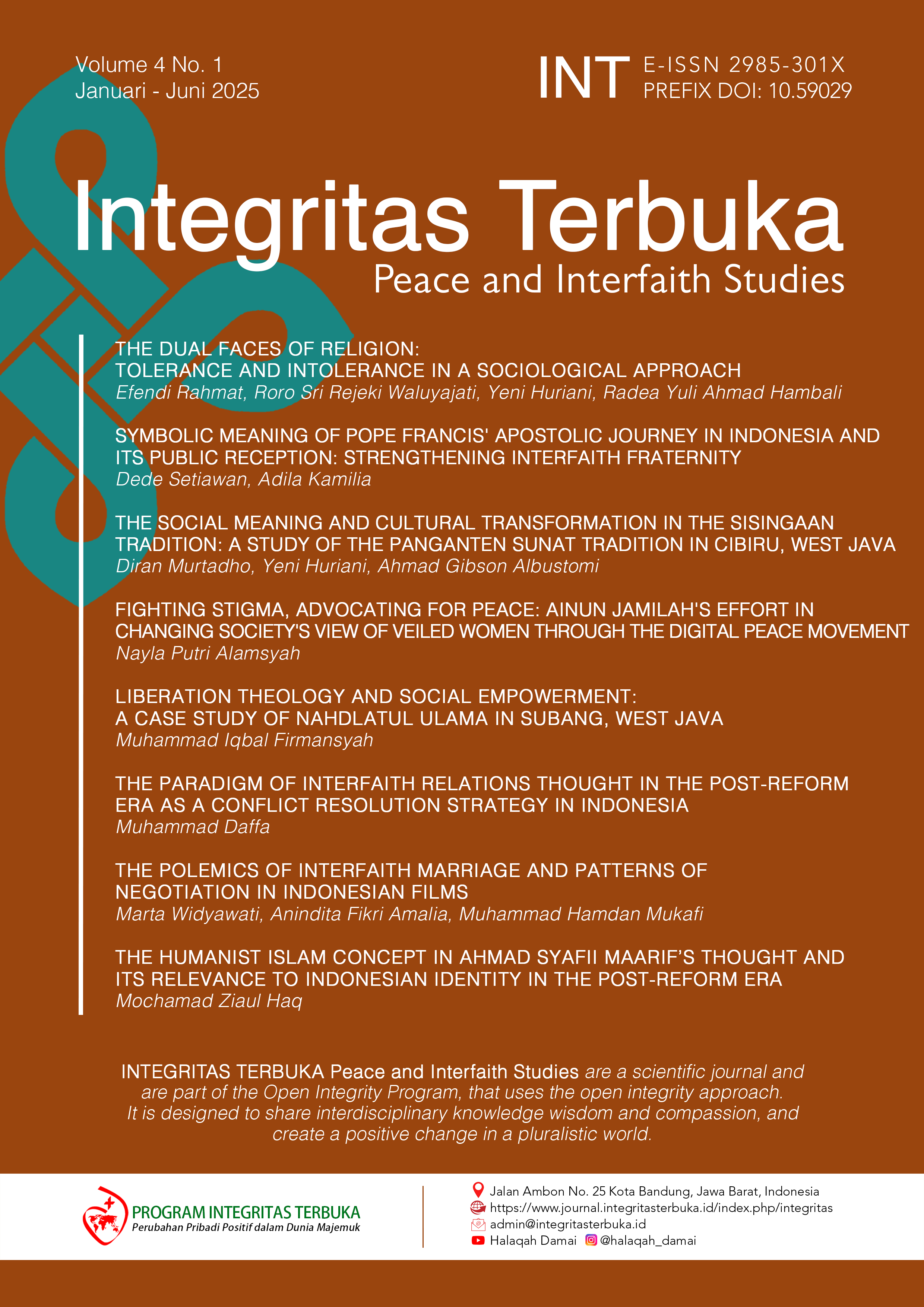
The Paradigm of Interfaith Relations Thought in the Post-Reform Era as a Conflict Resolution Strategy in Indonesia
DOI:
https://doi.org/10.59029/int.v4i1.59Abstract
Indonesia, as a country with high religious diversity, faces challenges in maintaining interfaith harmony, particularly in the post-Reform era of 1998, which expanded religious freedom while also increasing the risk of religion-based conflicts. This study aims to analyze the paradigm of interfaith relations in the post-Reform period and its contribution to resolving religious conflicts. Using a qualitative approach based on literature studies, this research examines various theories and perspectives of interfaith figures. The key findings indicate four phases in the dynamics of interfaith relations in Indonesia: the interfaith dialogue phase, which led to the emergence of interreligious communities; the advocacy phase, which focused on defending religious freedom rights; the creative campaign phase, which disseminated messages of tolerance through innovative media; and the intersectional phase, which integrates multiple approaches to develop inclusive policies. The academic contribution of this research lies in integrating various paradigms of thought, including neo-modernism, democratic socialism, universalism, liberative modernism, universal humanism, and non-violent conflict resolution, which can be implemented in religious diversity policies in Indonesia. However, this study has limitations in empirical research, and further studies are recommended to assess the effectiveness of these approaches through direct case studies and more specific policy analyses.
References
Abu-Nimer, M., & Smith, R. K. (2016). Interreligious and intercultural education for dialogue, peace and social cohesion. International Review of Education, 62(4), 393–405. https://doi.org/10.1007/s11159-016-9583-4
Bagir, Z. A. (2004). Interfaith Dialogue and Religious Education1. Muslim World, 94(3), 377–385.
Bagir, Z. A., Fauzi, I. A., Darningtyas, R., Mubarok, H., Rafsadi, I., & Kusumaningrum, D. (2023). Mengelola Konflik, Memajukan Kebebasan Beragama Ketegangan dalam Ragam Pendekatan Advokasi bagi Kelompok Terpinggirkan. Pusat Studi Agama dan Demokrasi (PUSAD), Yayasan Paramadina; Program Studi Agama dan Lintas Budaya, Sekolah Pascasarjana, Universitas Gadjah Mada; Sekber Koalisi Advokasi KBB Indonesia.
Chia, J. M.-T. (2018). Neither Mahāyāna Nor Theravāda: Ashin Jinarakkhita and the Indonesian Buddhayāna Movement. History of Religions, 58(1), 24–63.
Cianflone, M., Cull, J., Fisher, J., Holt, D., Krause, A., Julie, M., Anita, W., & Yancey, J. (2007). Anatomy of a Terrorist Attack: An In-Depth Investigation into the 2002 Bali, Indonesia, Bombings.
Cortina, R., & Winter, M. (2021). Paulo Freire’s Pedagogy of Liberation. Current Issues in Comparative Education, 23(2). https://doi.org/10.52214/cice.v23i2.8577
Coser, L. A. (1956). The Functions of Social Conflict. Routledge.
Daddow, A., Cronshaw, D., Daddow, N., & Sandy, R. (2021). Strengthening inter-cultural literacy and minority voices through narratives of healthy religious pluralism in higher education. International Journal of Inclusive Education, 25(10), 1174–1189. https://doi.org/10.1080/13603116.2019.1600056
Daffa, M. (2023). THE RELEVANCE OF THE ABU DHABI DOCUMENT AS A SUSTAINABILITY OF RELIGIOUS MODERATION IN INDONESIA FROM A HADITH PERSPECTIVE. Harmoni, 22(2), 248–266. https://doi.org/10.32488/harmoni.v22i2.701
Daffa, M., & Anggara, I. (2023). The Position of Local Religions in Interfaith Relations as a Form of Religious Moderation in Indonesia. Indonesian Journal of Religion and Society, 5(2), 112–124. https://doi.org/10.36256/ijrs.v5i2.369
Galamas, F. (2015). Terrorism in Indonesia: an overview. Research Papers, 4(10), 1–16.
Galtung, J. (2010). Peace Studies and Conflict Resolution: The Need for Transdisciplinarity. Transcultural Psychiatry, 47(1), 20–32. https://doi.org/10.1177/1363461510362041
Galtung, J., & Fischer, D. (2013). Johan Galtung: Pioneer of peace research (Vol. 5). Springer.
Hick, J. (1988). God And The Universe Of Faiths: Essays In The Philosophy Of Religion. Springer.
Hick, J. (2008). Religious Pluralism. Routledge.
Hutabarat, F. (2023). Navigating Diversity: Exploring Religious Pluralism and Social Harmony in Indonesian Society. European Journal of Theology and Philosophy, 3(6), 6–13. https://doi.org/10.24018/theology.2023.3.6.125
Imadudin, M. (2023). Hubungan Agama dan Negara: Dialektik dan Dinamika Antara Paradigma. INDEPENDEN: Jurnal Politik Indonesia Dan Global, 4(2), 61. https://doi.org/10.24853/independen.4.2.61-72
Imadudin, M., & Anis, M. (2023). Reinterpretasi Pancasila (Sebuah Dinamika Pemikiran dalam Relasi Agama dan Negara di Era Reformasi). EL-ADABI: Jurnal Studi Islam, 02(02), 1–25. https://doi.org/https://doi.org/10.59166/el-adabi.v2i2.52
Imparsial. (2024, December 10). Imparsial Temukan 23 Pelanggaran Kebebasan Beragama Selama 2024. Https://Imparsial.Org/Imparsial-Temukan-23-Pelanggaran-Kebebasan-Beragama-Selama-2024/.
Jadidah, F. (2020). Perubahan Konstitusi Dalam Transisi Orde Baru Menuju Reformasi Di Indonesia. Jurnal Ilmiah Mandala Education, 6(1). https://doi.org/10.58258/jime.v6i1.1120
Khudori, D. (2001). The altruism of Romo Mangun: The seed, the growth, the fruit. Indonesia and the Malay World, 29(85), 198–214. https://doi.org/10.1080/13639810120102067
Lumingga, R. S., & Humaedi, M. A. (2023). MENDIALOGKAN AGAMA: REFLEKSI KRITIS PEMIKIRAN TH. SUMARTANA. Harmoni, 22(2), 459–466. https://doi.org/10.32488/harmoni.v22i2.721
Mulyatno, C. B. (2020). Religiosity and Socio-Ecological Spirituality of Indonesian Community According to Y. B. Mangunwijaya. International Journal of Science and Society, 2(2), 394–408.
Oka, G. B. (1996). Gandhian experiment in primary education: the Indonesian experience. Indira Gandhi National Centre for the Arts (India).
Orton, A. (2016). Interfaith dialogue: seven key questions for theory, policy and practice. Religion, State and Society, 44(4), 349–365. https://doi.org/10.1080/09637494.2016.1242886
Pattipeilohy, S. Y. E. (2018). Ketuhanan yang BerkebudayaanKetuhanan yang Berkebudayaan: Memahami Pancasila sebagai Model Interkulturalitas. GEMA TEOLOGIKA, 3(2), 121. https://doi.org/10.21460/gema.2018.32.363
Prideaux, M., & Dawson, A. (2018). Interfaith activity and the governance of religious diversity in the United Kingdom. Social Compass, 65(3), 363–377. https://doi.org/10.1177/0037768618787241
Rakhmat, J. (2021). Halaman Akhir 1: Percikan Pemikiran Nalar Kritis Religius-Spiritual Islam (1st ed.). Bernas Ilmu Utama-Yayasan Jalan Rahmat.
Rosario, A. M. C. (2024). Conflict Resolution Through Interreligious Dialogue in a Multicultural Landscape: A Case Study in India’s Mosaic Society. Hamad Bin Khalifa University.
Saiya, N. (2015). The religious freedom peace. The International Journal of Human Rights, 19(3), 369–382. https://doi.org/10.1080/13642987.2015.1032268
Setiawan, W., Sari, A. Y., Novianto, R., & Aurel, S. (2024, December 9). Jalsah Salanah Ahmadiyah Dilarang, Prabowo Gagal Menjamin Kebebasan Beragama. Https://Kbr.Id/Berita/Nasional/Jalsah-Salanah-Ahmadiyah-Dilarang-Prabowo-Gagal-Menjamin-Kebebasan-Beragama.
Sumartana, T. (1994). Mission at the crossroads: indigenous churches, European missionaries, Islamic association and socio-religious change in Java. BPK Gunung Mulia.
Syarifuddin, Muzammil, S., & Wasil. (2023). Mukti Ali’s scientific-cum-doctrinaire approach and Ibn Arabi’s wahdat al-adyan in strengthening religious moderation. IJoReSH: Indonesian Journal of Religion, Spirituality, and Humanity, 2(2), 158–179. https://doi.org/10.18326/ijoresh.v2i2.158-179
Tidore, B. (2020). ResolusiKonflik Berbasis Teologi BakuBae: studi konflik Ambon 1999-2002. UIN Syarif Hidayatullah.
Yuliantri, R. D. A. (2024). Social and Cultural Integration: A Discourse Analysis of Islamic Themes in the Basis Magazine, 1998–2000. Indonesian Historical Studies, 8(2), 171–188. https://doi.org/10.14710/ihis.v8i2.20522
Downloads
Published
Issue
Section
License
Copyright (c) 2025 Muhammad

This work is licensed under a Creative Commons Attribution-ShareAlike 4.0 International License.
Attribution-ShareAlike 4.0 International (CC BY-SA 4.0)
You are free to:
Share - copy, and redistribute the material in any medium or format.
Adapt — remix, transform, and build upon the material for any purpose, even commercially. The licensor cannot revoke these freedoms as long as you follow the license terms.
Under the following terms:
Attribution — You must give appropriate credit, provide a link to the license, and indicate if changes were made. You may do so in any reasonable manner, but not in any way that suggests the licensor endorses you or your use.
ShareAlike — If you remix, transform, or build upon the material, you must distribute your contributions under the same license as the original.
This license is acceptable for Free Cultural Works - https://creativecommons.org/licenses/by-sa/4.0/