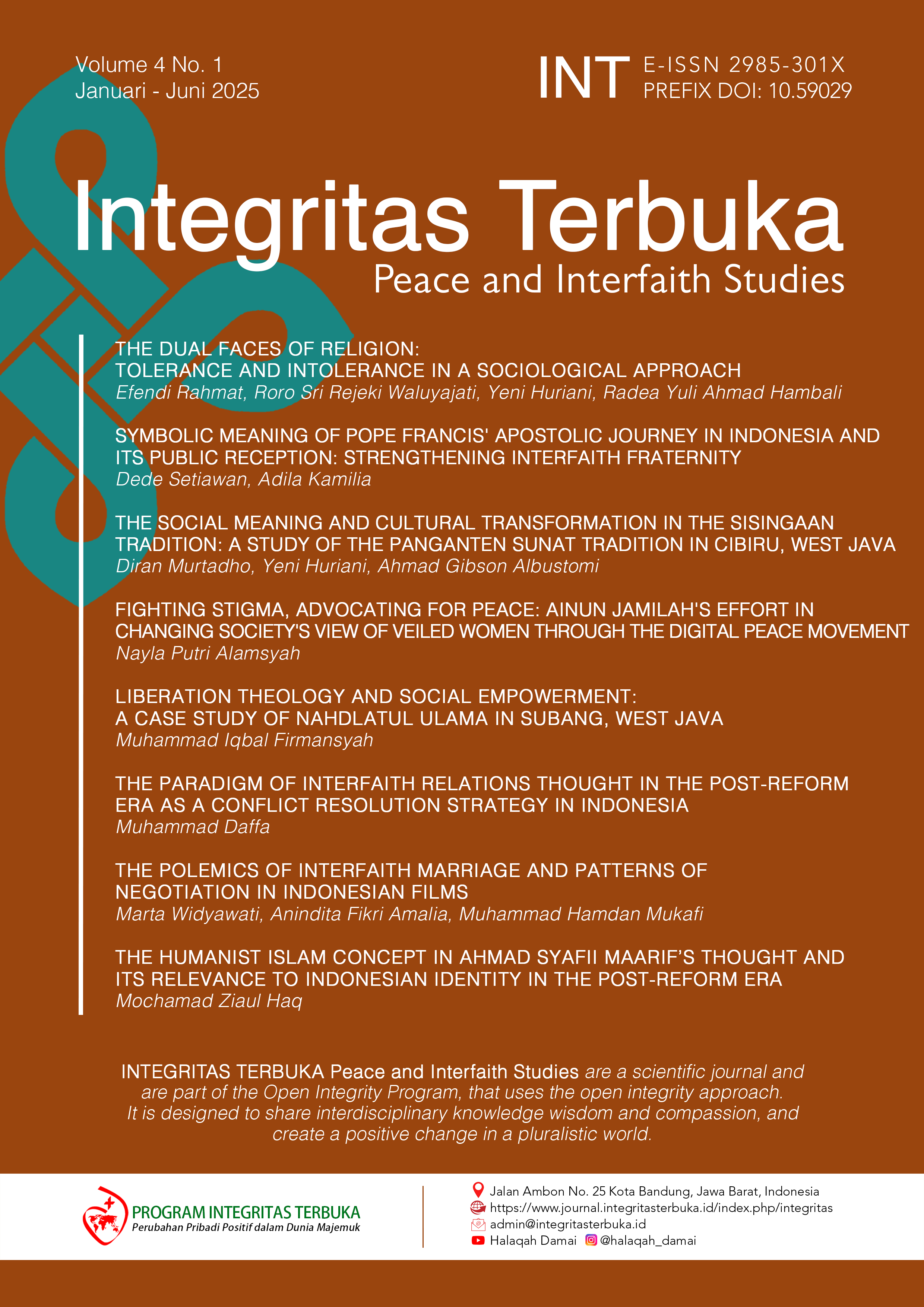
Fighting Stigma, Advocating for Peace: Ainun Jamilah's Effort in Changing Society's View of Veiled Women Through the Digital Peace Movement
DOI:
https://doi.org/10.59029/int.v4i1.58Keywords:
Veiled Women;, Social Stigma; ., Social Media;, Peace;, Religious ModerationAbstract
This study aims to explore the role of Ainun Jamilah and the Cadar Garis Lucu community in combating the negative stigma against veiled women in Indonesia, as well as to analyze the impact of the peace movement promoted through social media. The research adopts a mixed-methods approach (quantitative-qualitative) through the collection of survey data, in-depth interviews, and online observation, particularly focusing on the Cadar Garis Lucu Instagram account (@cadargarislucu). The study found a contradiction in public perceptions; where although many still view veiled women with a negative stigma, they also support the peace efforts carried out by veiled women via digital platforms. Through the Cadar Garis Lucu movement, Ainun Jamilah plays a key role in redefining the image of veiled women by promoting the values of religious moderation and peace. Through various educational content and interfaith dialogues, she facilitates, Ainun has successfully introduced a new face of veiled women as open, inclusive, and tolerant despite still facing negative stigma related to their appearance. This research contributes to the understanding of how social media can be used to advocate for peace and reduce stigma against marginalized groups. The contribution of this study lies in the application of religious moderation theory in the digital context and the use of social media to promote inclusivity and intergroup dialogue.
References
AJI Indonesia. (2024). Kampanye Pemilu 2024, Ujaran Kebencian terhadap Kelompok Minoritas Meningkat. Aliansi Jurnalis Independen Indonesia. Retrieved from https://aji.or.id/informasi/kampanye-pemilu-2024-ujaran-kebencian-terhadap-kelompok-minoritas-meningkat
Amelia, R. M. (2018). Jangan Islamofobia Hanya Karena Wanita Bercadar! News.Detik.Com. Retrieved from https://news.detik.com/berita/d-4029993/jangan-islamofobia-hanya-karena-wanita-bercadar
Berger, P. L., & Luckmann, T. (1991). The social construction of reality: A treatise in the sociology of knowledge. Penguin Uk.
BNPT RI. (2024). BNPT: 180 Ribu Konten Bermuatan Terorisme Diblokir Sepanjang 2024. BNPT RI. Retrieved from https://www.bnpt.go.id/bnpt-180-ribu-konten-bermuatan-terorisme-diblokir-sepanjang-2024
Cauldron Content. (2023). Perjuangan Seorang Pancasilais Bercadar feat. Ainun Jamilah - Uncencored with Andini Effendi ep.24. Cauldron Content. Retrieved from https://youtu.be/GAI1dZ4XE6c?si=mpP_l-nN0ZgiRN4V
Chapman, M. (2016). Veil as stigma: Exploring the role of representations in Muslim women’s management of threatened social identity. Journal of Community & Applied Social Psychology, 26(4), 354–366.
Craswell, J. W. (2009). Research Design: Qualitative, Quantitative, and Mixed Methods Approaches. Los Angeles: Sage Publications.
Diamond, L. M., & Alley, J. (2022). Rethinking minority stress: A social safety perspective on the health effects of stigma in sexually-diverse and gender-diverse populations. Neuroscience & Biobehavioral Reviews, 138, 104720.
Donnelly, C. M., & Wright, B. R. E. (2013). Goffman goes to church: Face-saving and the maintenance of collective order in religious services. Sociological Research Online, 18(1), 143–155.
Fahira, A. (2025). Cadar Garis Lucu, Suara Perempuan untuk Perdamaian. Bincang Perempuan. Retrieved from https://bincangperempuan.com/cadar-garis-lucu-suara-perempuan-untuk-perdamaian/
Frost, D. M. (2011). Social stigma and its consequences for the socially stigmatized. Social and Personality Psychology Compass, 5(11), 824–839.
Goffman, E. (1963). Stigma: Notes on the Management of Spoiled Identity. In Prentice-Hall.
Göle, N. (2003). The voluntary adoption of Islamic stigma symbols. Social Research: An International Quarterly, 70(3), 809–828.
Gunawan, N. A. A., Sulistyani, H. D., & Yuliyanto, M. (2021). Negosiasi Identitas Perempuan Bercadar dalam Menghadapi Stigma Attached To Identification selama Proses Pembelajaran. Interaksi Online, 10(1), 113–125.
Hamdi, S. (2022). Covid-19, social stigma and changing religious practice in Tablighi Jamaat communities in Lombok, Indonesia. International Journal of Disaster Risk Reduction, 76, 102996.
Hardiyanto, S. (2018). Hapus Stigma Negatif, Begini Aksi Para Perempuan Bercadar. Jawa Pos. Retrieved from https://www.jawapos.com/berita-sekitar-anda/0187263/hapus-stigma-negatif-begini-aksi-para-perempuan-bercadar
Herli, A. (2021). Perempuan Bercadar Kian Khawatir Akan Stigma Negatif. Valid News Id.
Hossain, M. Z., & Mughal, F. (2021). Dementia and revivalist Islam: New perspectives to understanding dementia and tackling stigma. Journal of Evaluation in Clinical Practice, 27(2), 213–217.
Islam, M. T. (2019). The impact of social media on muslim society: From islamic perspective. International Journal of Social and Humanities Sciences, 3(3), 95–114.
Katz, Y. (2020). Interacting for Peace: rethinking peace through interactive digital platforms. Social Media+ Society, 6(2), 2056305120926620.
Kerr, N. A., & Stanley, T. B. (2021). Revisiting the social stigma of loneliness. Personality and Individual Differences, 171, 110482.
Maharani, S. (2024). Kampanye Toleransi Komunitas Cadar Garis Lucu. Tempo.Co. Retrieved from https://www.tempo.co/arsip/komunitas-cadar-garis-lucu-26534
Melynda, S. (2021). Cadar Garis Lucu Memaknai dan Meluruskan Citra Perempuan Bercadar. NU Jabar Online. Retrieved from https://jabar.nu.or.id/daerah/cadar-garis-lucu-memaknai-dan-meluruskan-citra-perempuan-bercadar-jmInw
Miles, M. B., & Huberman, A. M. (2013). Qualitative Data Analysis: An Expanded Sourcebook. London and New Delhi: Sage Publications, Inc.
Mulyana, R. (2023). Religious moderation in Islamic religious education textbook and implementation in Indonesia. HTS Teologiese Studies/Theological Studies, 79(1), 8.
Nababan, W. M. C. (2024). Sepanjang 2024, Ada 2.264 Akun Medsos Sebarkan Konten Terorisme. Kompas.Id. Retrieved from https://www.kompas.id/artikel/sepanjang-2024-ada-2264-akun-medsos-dan-10519-konten-berbau-terorisme
Nichols, T. R., Welborn, A., Gringle, M. R., & Lee, A. (2021). Social stigma and perinatal substance use services: Recognizing the power of the good mother ideal. Contemporary Drug Problems, 48(1), 19–37.
Punziano, G., De Falco, C. C., & Trezza, D. (2023). Digital mixed content analysis for the study of digital platform social data: An illustration from the analysis of COVID-19 risk perception in the Italian Twittersphere. Journal of Mixed Methods Research, 17(2), 143–170.
Putra, N. (2024). Imparsial: 23 Kasus Pelanggaran Kebebasan Beragama Terjadi Sepanjang 2024. Tempo.Co. Retrieved from https://www.tempo.co/politik/imparsial-23-kasus-pelanggaran-kebebasan-beragama-terjadi-sepanjang-2024-1179825
Rahayu, W. H., Utari, P., & Wijaya, M. (2019). The Motivation of Hoax Message Recipients in the Process of Disseminating Hoax Information on Facebook Group. International Journal of Multicultural and Multireligious Understanding, 6(4), 414. https://doi.org/10.18415/ijmmu.v6i4.1015
Rahman, A. F., & Syafiq, M. (2017). Motivasi, stigma dan coping stigma pada perempuan bercadar. Jurnal Psikologi Teori Dan Terapan, 7(2), 103–115.
Richmond, O. P. (2020). Peace in analogue/digital international relations. Global Change, Peace & Security, 32(3), 317–336.
Setia, P., & Haq, M. Z. (2023). Countering Radicalism in Social Media by Campaigning for Religious Moderation. Focus, 4(1), 13–24.
Setia, P., & Rahim, R. A. A. (2024). The Role of Nahdlatul Ulama in Promoting Peace in A Digital Era. Hanifiya: Jurnal Studi Agama-Agama, 7(1), 73–86.
Siddiqui, S., & Singh, T. (2016). Social Media its Impact with Positive and Negative Aspects. International Journal of Computer Applications Technology and Research, 5(2), 2319–8656.
Sinambela, N. M. (2024). BNPT-Kemkomdigi “take down” 180.954 konten radikalisme di media sosial. Antaranews.Com. Retrieved from https://www.antaranews.com/berita/4545666/bnpt-kemkomdigi-take-down-180954-konten-radikalisme-di-media-sosial
Strabac, Z., Aalberg, T., Jenssen, A. T., & Valenta, M. (2016). Wearing the veil: hijab, Islam and job qualifications as determinants of social attitudes towards immigrant women in Norway. Ethnic and Racial Studies, 39(15), 2665–2682.
Subchi, I. (2022). Religious Moderation in Indonesian Muslims. Religions, 13(5). https://doi.org/10.3390/rel13050451
Wardani, M. K. (2021). Cadar Garis Lucu, Upaya Muslimah Bercadar Kikis Stigma. KBR.Id. Retrieved from https://kbr.id/berita/nasional/cadar-garis-lucu-upaya-muslimah-bercadar-kikis-stigma
Zaid, B. (2022). Digital Islam and Muslim Millennials: How Social Media Influencers Reimagine Religious Authority and Islamic Practices. Religions, 13(4). https://doi.org/10.3390/rel13040335
Downloads
Published
Issue
Section
License
Copyright (c) 2025 Nayla Putri Alamsyah

This work is licensed under a Creative Commons Attribution-ShareAlike 4.0 International License.
Attribution-ShareAlike 4.0 International (CC BY-SA 4.0)
You are free to:
Share - copy, and redistribute the material in any medium or format.
Adapt — remix, transform, and build upon the material for any purpose, even commercially. The licensor cannot revoke these freedoms as long as you follow the license terms.
Under the following terms:
Attribution — You must give appropriate credit, provide a link to the license, and indicate if changes were made. You may do so in any reasonable manner, but not in any way that suggests the licensor endorses you or your use.
ShareAlike — If you remix, transform, or build upon the material, you must distribute your contributions under the same license as the original.
This license is acceptable for Free Cultural Works - https://creativecommons.org/licenses/by-sa/4.0/